You are standing in your parent's house with the keys in your hand, and every room is full. Maybe your parent has passed, maybe they have moved to care and the house needs to be emptied, and either way you have a job and a family and a flight home in a few days. This guide gives you the order to do things in, so you protect what matters, waste no trips, and get to the last broom without breaking yourself.
Before you touch anything, settle three questions
The urge on day one is to grab a trash bag and start. Resist it for an hour. Three things need answers first, because getting them wrong later costs far more time than getting them right now.
First, who has the authority to decide? If your parent is living, it is your parent, and you are helping. If your parent has passed, the will names an executor, and until the estate is opened at the county Register of Wills, nobody should be giving away or selling anything of value. Confirm the specifics with the family attorney or the county office. A few days of waiting beats a family rupture.
Second, is the house safe and running? Walk through and check that the furnace, water, and electricity are on. Western Pennsylvania winters will freeze pipes in an empty house in a single cold night, so if it is November through March, keep the heat on low until the day the house changes hands.
Third, who else needs to be in the loop? Text your siblings before you move a single box. One message that says "I am starting on the house this weekend, here is my plan, tell me by Friday if there is anything you want me to set aside" prevents most of the arguments that follow.
Set the house up so the work can actually happen
An unprepared cleanout is just moving piles from one room to another. Twenty minutes of setup at the start saves you a full day later.
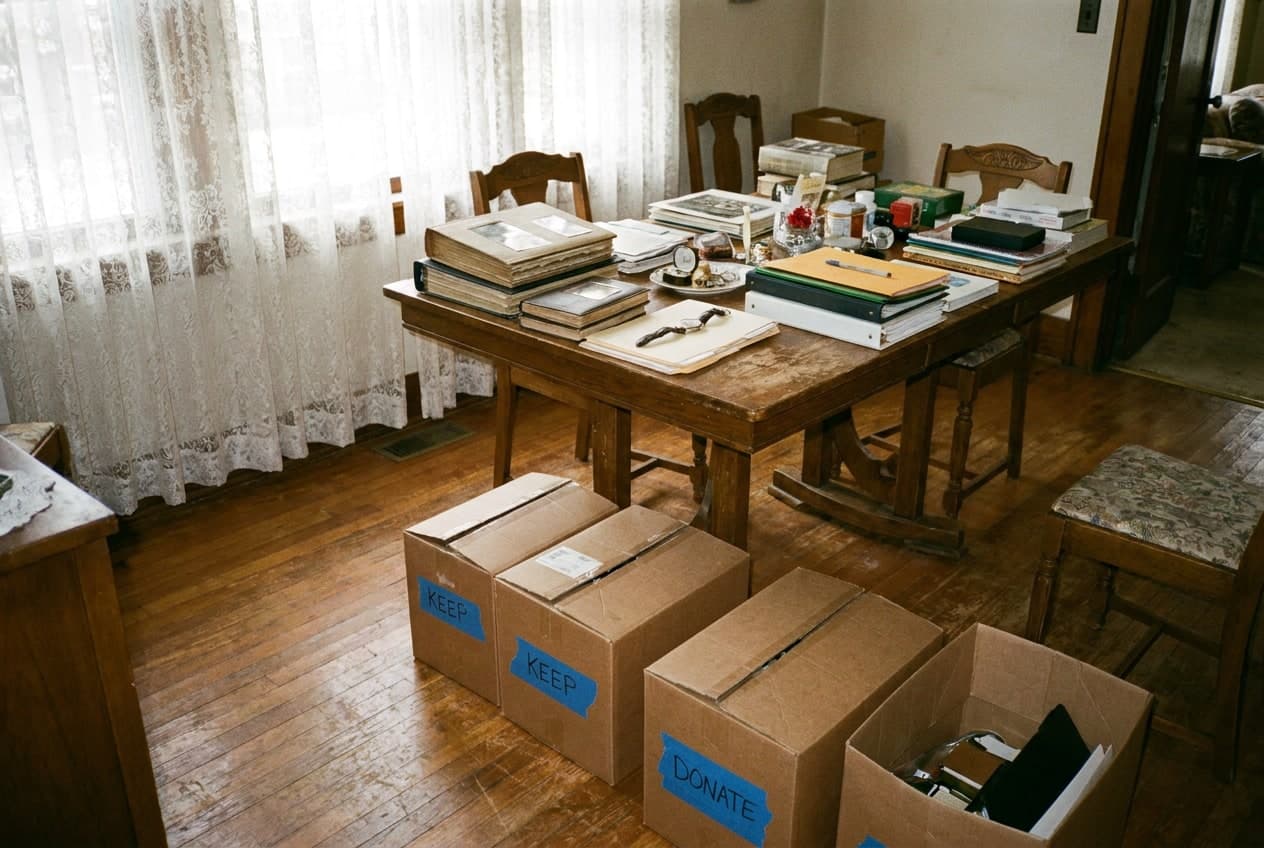
Pick one room, usually the dining room or living room, as the sorting room. Clear the table. This is where everything that needs a decision goes, and where the family will eventually stand and choose. Then claim one closed space, a spare bedroom or a locked car trunk, as the keep zone. Nothing goes in there unless it is definitely staying with the family.
Bring supplies with you rather than hunting for them: contractor bags, a few dozen boxes, painter's tape and a marker for labels, gloves, a box cutter, a lamp with a bright bulb for the basement, and a folder for papers. Buy more boxes than you think you need. Everyone underestimates.
- Sorting room: one cleared table, plus floor space marked with tape into Keep, Family, Donate, Sell, Trash.
- Keep zone: a closed room or your car. Small, so you stay honest about it.
- Papers folder: every envelope, statement, and official-looking letter goes here unread. You sort them at night, not on your feet.
- Photo box: one box for every loose photograph, album, and slide carousel. You do not look at them yet. You just gather them.
Find and protect what matters before you clean out anything
The first real pass through the house is not a cleanout. It is a search. You are looking for the things that cannot be replaced and the things that have real value, and you are getting them out of the house or locked up before anyone else walks through, including well-meaning neighbors and hired help.
Older people hid things in the places that made sense to them. Check coat pockets in the hall closet, the freezer behind the ice cream, the bottom of the flour canister, inside books on the nightstand, under the mattress, the tackle box, the sewing tin, and every purse in the closet. Check the toes of dress shoes. Check the back of the top dresser drawer where the drawer does not quite meet the frame.
You are looking for the deed, the will, insurance policies, bank and pension statements, the car title, tax returns from recent years, safe deposit keys, and passwords written on index cards. You are also looking for jewelry, cash, coin collections, military medals, and the small sentimental things: wedding rings, a father's watch, letters tied with ribbon. Everything in this pass goes into the keep zone or leaves with you that night.
Do this pass slowly, and do it yourself or with one sibling you trust. It is the single most important few hours of the whole project, and it is the part that gets skipped when someone rushes.
The order of rooms when you clean out a parent's house
Start with the rooms that hold the most volume and the least feeling. That is not cold. It is strategy. You build momentum, you free up floor space to sort in, and you save your emotional energy for the rooms that will need it.
Bathrooms and linen closets go first. Expired medicine, half-used shampoo, towels worn thin. Almost nothing here needs a family vote, and you can clear both in an afternoon. Take unused prescriptions to a pharmacy or police station drop box rather than the trash. Then the kitchen: the pantry of cans from years past, the drawer of twist ties, the mismatched storage containers. Set aside a few good pots and the everyday dishes in case someone wants them, and box the rest for donation.
Next comes the living room and dining room furniture, which is mostly a question of who wants it and how it leaves, then the bedrooms, which are harder because of clothing and personal effects. Leave the closet of your parent's clothes for a day when you have help and time, not the last hour before your flight.
Basements and attics go last. Nearly every house in this region has a full basement, and it is where forty years of paint cans, holiday decorations, tax boxes, and a workbench of tools have settled. It is the heaviest work, the dirtiest, and the one where you will most want a strong back and a truck. Do not open it until the rest of the house has taught you how you sort.
Deciding what stays in the family without a fight
Most cleanout conflicts are not about money. They are about a casserole dish, a clock, or the feeling of being left out. A little structure prevents nearly all of it.
Once the sorting room is full, hold one family session. Everyone who has a say is there in person or on a video call. Go around the room one item at a time, and let each person claim in turn, like picking teams. When two people want the same thing, the tie goes to whoever has the strongest story about it, and if nobody can agree, it goes in a box to be decided in a month when everyone is calmer. Write every decision down as you go. A list on your phone is enough.
For siblings who live far away, photograph everything on the table and text the pictures with a deadline. "Claim by Sunday night or it goes to donation." A clear deadline is a kindness. Open-ended offers keep the house full for months.
Give yourself the rule of one. One box of your mother's handwriting. One of your father's tools that you will actually use. The instinct is to keep everything because throwing it out feels like throwing them out. It is not. The love was never in the gravy boat.
Getting everything out: donation, sale, and haul-away
Once the family has chosen, the rest of the house is logistics, and logistics reward a schedule. Book the donation pickup and the dumpster or hauler for specific days before you finish sorting, because the deadline will pull the sorting along.
Furniture in decent shape can often be picked up by charity organizations if you schedule ahead, and clothing, kitchenware, and books go in the car to a drop-off. Get a receipt for every donation and put it in the papers folder. Anything you think might sell, from good furniture to tools to the china nobody claimed, is worth a quick look from an estate sale company or a consignment shop before it goes to the curb, but be honest with yourself: most household goods are worth far less than they were paid for, and your time has value too.
The basement shelves of paint cans, the old propane tank, the bottles under the sink, and the fluorescent tubes cannot go in the regular trash. Most counties in the region hold hazardous waste collection days a few times a year; check the county website for dates and what they accept. Old electronics have their own rules in Pennsylvania as well, so plan a separate trip for the tube television and the box of cords.
Everything left after donation and sale is haul-away. A junk hauler or a dumpster for a long weekend handles it, and this is the point where many families realize they would rather pay someone with a truck than make a twelfth trip to the transfer station.
The last broom, and what to do if you cannot carry all of it
When the house is empty, walk every room with the lights on. Open every cabinet, closet, and drawer. Check the garage rafters and the top of the water heater. Then clean: floors, bathrooms, inside the refrigerator, the kitchen cabinets. A clean, empty house shows well to a buyer and closes a chapter the right way.
Take a final set of photographs of each empty room for your own records, gather the keys and garage openers into one envelope, and make a short list of what the next owner or the realtor needs to know: the furnace filter size, where the water shutoff is, which window sticks.
The plan above is realistic for a family with several free weekends and at least two people on the ground. Many families do not have that. If you live hours away, work full time, or are the only child and simply cannot spend another Saturday in your parent's basement, you can hand the whole thing to one person. Homeward Guide Co. does exactly this for families in Pittsburgh, Cranberry, and Beaver and Butler counties: one point of contact who runs the sort, records every family decision, coordinates donations and haul-away, and leaves the house clean and ready for sale. You stay in the decisions and stop carrying the boxes. Either way, the order in this guide will get you there. You do not have to do it all yourself, and you do not have to do it alone.
Common questions
- Where do I start when cleaning out my parents' house?
- Start with a search, not a cleanout. Find and secure the important papers, jewelry, cash, and irreplaceable keepsakes first, then set up a sorting area. Only then begin with low-emotion rooms like bathrooms and the kitchen to build momentum.
- How long does it take to clean out a parent's house?
- For a full house with a basement, most families need several weekends spread over a couple of months if they are working on their own. With two or three people on the ground and a hauler booked, a long weekend can clear most of the volume. The sorting and family decisions take longer than the physical moving.
- What should I not throw away when cleaning out a parent's house?
- Keep every official-looking paper until it has been read: deeds, wills, insurance policies, statements, and tax returns. Keep photographs and letters in one box to sort later. Also hold anything that might have value, such as jewelry, coins, medals, and tools, until the family has decided together.
- Can I clean out my parent's house before probate?
- You can secure the house, remove perishables, and protect valuables, but you should not sell or give away significant belongings until the executor has authority from the county Register of Wills. Rules and timing vary, so confirm with the family attorney or the county before major disposals.
- How do I clean out a parent's house from out of state?
- Concentrate your visits: one trip to secure papers and valuables and set up the house, one to sort with family present, and one to finish. Between trips, use photos and deadlines to get sibling decisions, and hire local help for the haul-away and cleaning rather than trying to do it in airport layovers.