You are standing in a house that took forty years to fill, and it has to fit into something much smaller within a few months. Every drawer feels like a decision, and the decisions keep stalling. This guide gives you one method with five words, then walks it through the actual rooms of a Western Pennsylvania home so you know what to keep, what goes to family, and what leaves.
Start With the New Home, Not the Old One
The most common mistake is walking through the old house asking "do I love this?" You love most of it. That is why it is still here. The question that produces decisions is "where will this sit in the new place?"
Before you open a single closet, get the floor plan of the apartment, the patio home, or the room in the community. Measure the walls. Count the kitchen cabinets and the closet rods. Draw the bed, the dresser, the one good chair, and the television on paper. Whatever space is left is the budget for everything else.
That budget makes the rest of this method work. When you know there are eleven upper cabinets instead of twenty-six, the fourth set of mixing bowls stops being a sentimental question and becomes a math question. Math questions are much easier to finish at the end of a long day.
The Five Words and What Each One Really Means
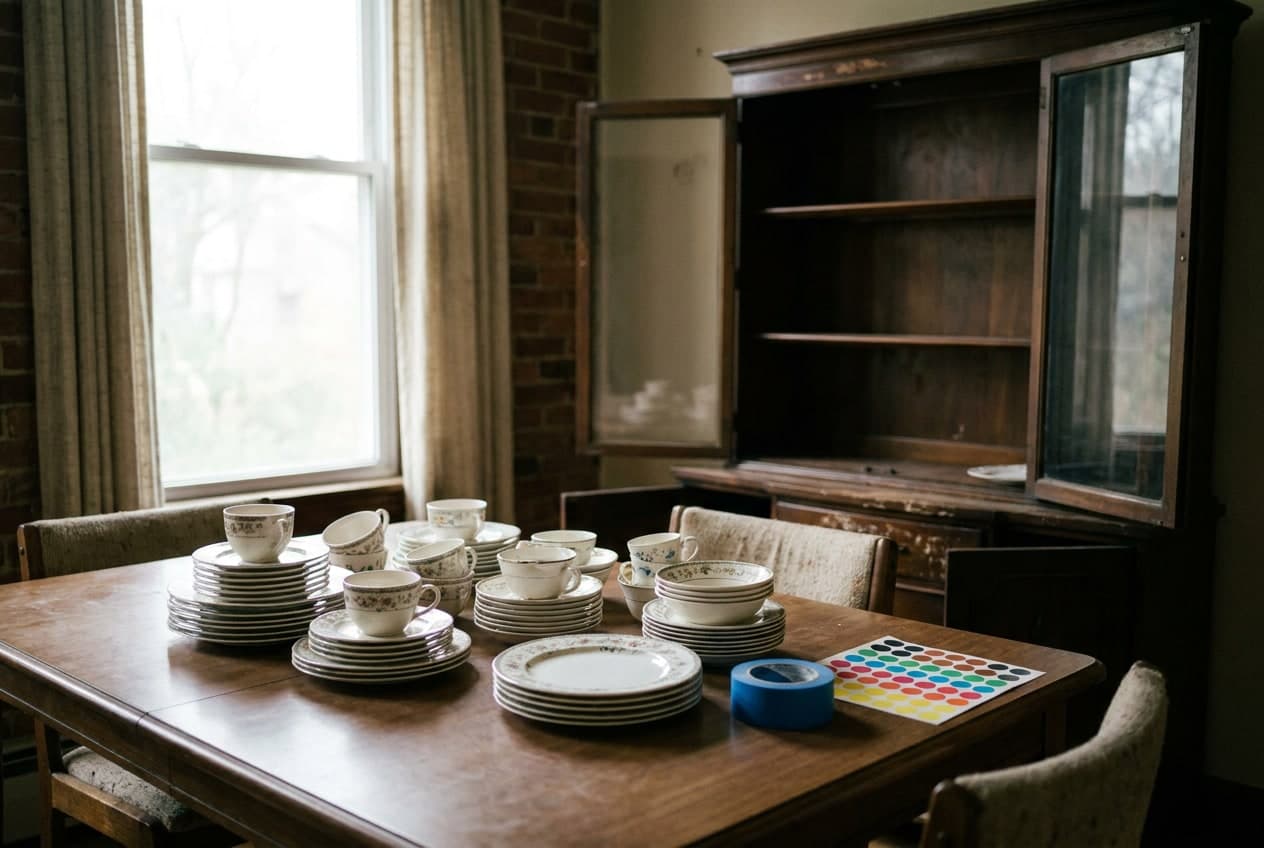
Use five words and only five. Every object in the house lands in exactly one of them. Write each word on a colored piece of tape or a sticky dot and keep the roll in your pocket. A label on the thing beats a note on a legal pad, because the note gets lost and the thing gets moved.
Here is what each word means in practice:
- Keep: it fits the floor plan, it will be used within the first month in the new home, or it is one of a small handful of irreplaceable pieces you have chosen on purpose.
- Family: a specific named person has said yes to it and has said when they will pick it up. "Someone might want this" is not family. It is a stall.
- Sell: it has genuine resale value to a stranger and someone is willing to do the work of selling it. Most household goods do not clear this bar, and that is fine.
- Donate: it is clean, working, and something a charity actually accepts. Broken lamps and stained mattresses are not donations, and the truck will refuse them.
- Remove: everything else. Paint cans, the box of cords from devices nobody owns, the water-stained luggage, the recliner with the collapsed spring. This pile is larger than anyone expects, and it should be.
What to Keep From the Kitchen and Dining Room
Kitchens are where the method gets its first real test, because nearly everything works and nearly everything has a memory attached. Start with the things used every week: the good frying pan, the coffee maker, the everyday plates, a few sharp knives, the one pot that makes soup. Those are Keep, and they should fill the new cabinets first.
Then look at duplicates. Three colanders, two sets of measuring cups, the electric knife from a wedding decades ago, the bread machine that lives in the basement. One of each goes forward. The rest are Donate if they work and are clean.
The dining room holds the hardest calls: the china, the silver, the hutch itself. Ask each child or grandchild directly, by name, whether they want the china. Get a yes or a no. If it is a yes, it is Family with a pickup date. If every answer is no, it is Sell or Donate, and that is not a failure. A set of dishes that sat in a cabinet for thirty years was already not being used. Keep one teacup or the gravy boat if you want a piece of the memory without the weight of twelve place settings.
Bedrooms, Closets, and the Linen Shelves
Clothing is where the new home's closet rod does the deciding. Measure it. Then pull only the clothes worn in the last year and see how much rod they take. In most longtime homes that is a fraction of what hangs there, and it usually fits.
Everything else divides cleanly. Good coats, suits, and shoes in wearable shape are Donate, and winter coats in particular are wanted by local shelters every fall. Anything stained, stretched, or from a size not worn in a decade is Remove. Do not keep the aspirational wardrobe for a body that may return. The new closet cannot hold it.
Linens follow the same rule. Two sets of sheets for each bed that is actually moving, four towels per person, one spare blanket. Old towels can go to an animal shelter. Yellowed tablecloths and the mattress pad from a bed that no longer exists are Remove.
The nightstand and dresser tops are different. This is where the small heavy things live: the wedding ring in a dish, the watch, the letters. Sweep those into a single labeled box marked Keep before anything else in the room moves. Losing a ring in a moving box is a very real fear and a very preventable one.
The Basement, Garage, and Attic
Here is the truth about the basement in an older Western Pennsylvania house: almost all of it is Remove, and almost none of it is a hard decision. It only feels hard because of the volume and the stairs.
Walk down with a flashlight and just look. The shelves of paint cans with rusted lids. Storm windows for a house that got replacement windows years ago. The fake Christmas tree with the bent trunk, the deep freezer with three unlabeled packages, the exercise bike, the stack of coolers, the boxes of canning jars. Tools that still work and are not duplicates are Keep or Family. Everything else is Remove, and paint, chemicals, and old electronics need to go to a county household hazardous waste collection rather than the curb. Check your county's schedule, because those events are seasonal and fill up.
Garages and attics hold the same categories with a twist: they often hold other people's things. The adult child's college boxes, the grandchild's crib, a sibling's golf clubs. Those get a phone call and a deadline. If the owner does not claim them by the date you set, they become Donate or Remove. You are not the storage unit anymore, and saying so kindly is part of downsizing.
One safety note that matters more than it sounds. Steep basement stairs, low ceilings, and forty years of damp are a real hazard for someone in their seventies or eighties. Carrying boxes up them is not a job for the person downsizing. It is a job for younger backs or a hired crew, full stop.
Paper, Photographs, and the Things That Stall Everyone
Paper is not a Keep or Remove question. It is a sorting question with three bins: current, historical, and shred. Current means anything tied to money, insurance, property, or medical care in the last few years. Historical means the deed, the marriage certificate, military discharge papers, birth certificates. Shred means the utility bills from the previous decade, the expired warranties, and the bank statements from accounts long closed. If the person downsizing is also handling an estate or a Medicaid application, ask the attorney or the county which records to hold before shredding anything.
Photographs get their own box and their own afternoon, not this one. Pull every loose photo, album, and slide carousel into one large bin labeled Keep and move it to the new home unsorted. Sorting photos during a move is how the move stops. It can happen later, at a kitchen table, with a grandchild scanning the good ones.
Then there are the objects that stall a whole day: the father's workbench, the sewing machine, the piano. The method still applies. A named person and a pickup date makes it Family. A real buyer makes it Sell. Otherwise it is Donate or Remove, and it helps to say out loud that keeping a piano nobody plays in a house nobody lives in does not honor the person who played it.
Rules for When You Get Stuck
Every family hits a wall around the second weekend. These rules get people moving again:
- Set a Maybe box, and cap it at one box. When it is full, the next Maybe forces something out. The box moves to the new home and gets opened after the first month.
- Take a photo of anything you are letting go of but want to remember. The picture holds the memory. The object was only holding the picture.
- Decide by the item, not the pile. "What do we do with all this?" has no answer. "Does this waffle iron go to the new kitchen?" has one.
- Give the person downsizing the final word on Keep, and give the helpers the final word on Remove. It balances the pull toward saving everything against the pull toward clearing it fast.
- Stop before you are exhausted. Decisions made at nine at night after eight hours of sorting get undone the next morning.
You Do Not Have to Carry Every Piece of This
The method above works. It works because it turns feelings into a floor plan and a label, and it holds up even when siblings live in three different states and the person downsizing is tired by lunch. But knowing what to do and having the hands, the truck, the time off work, and the calm to do it are different things.
If the sorting is the part you want to keep, keep it, and hand off the rest: the donation runs, the hazardous waste trips, the hauling, the deep clean, the listing prep. If even the sorting feels like too much, a company like Homeward Guide Co. will sit at the table with the family, run the sessions, keep the written record of who said yes to the china, and then carry everything through to the last broom. One phone call, one point of contact, and the house gets finished without anyone in the family having to hold the whole thing.
Either way, start with the floor plan tomorrow. Buy the tape. Label the first drawer. The house gets smaller one honest decision at a time.
Common questions
- How do I decide what to keep when downsizing to a small apartment?
- Measure the new space first and draw the furniture on a floor plan, then keep only what fits and what you will use in the first month. Everything else gets one of four other labels: family, sell, donate, or remove. Sentiment gets a single small box, not a room.
- What should you not get rid of when downsizing?
- Do not let go of legal papers such as the deed, birth and marriage certificates, and military records, and do not shred financial records without checking with an attorney if an estate or Medicaid application is involved. Keep photographs in one bin to sort later. Keep any daily-use item that would cost money to replace within the month.
- How do you decide what to keep and what to give to family?
- An item is a family item only when a specific person has said yes to it and agreed on a pickup date. Ask each relative directly by name rather than announcing to the group that things are available. If nobody claims it, it goes to sell, donate, or remove without guilt.
- What do you do with a lifetime of stuff in the basement when downsizing?
- Most of a longtime basement is remove, not a decision. Working tools and a few genuine keepsakes come up; paint, chemicals, and old electronics go to a county hazardous waste collection; the rest is hauled. The stairs are the real problem, so plan for younger helpers or a crew to carry.