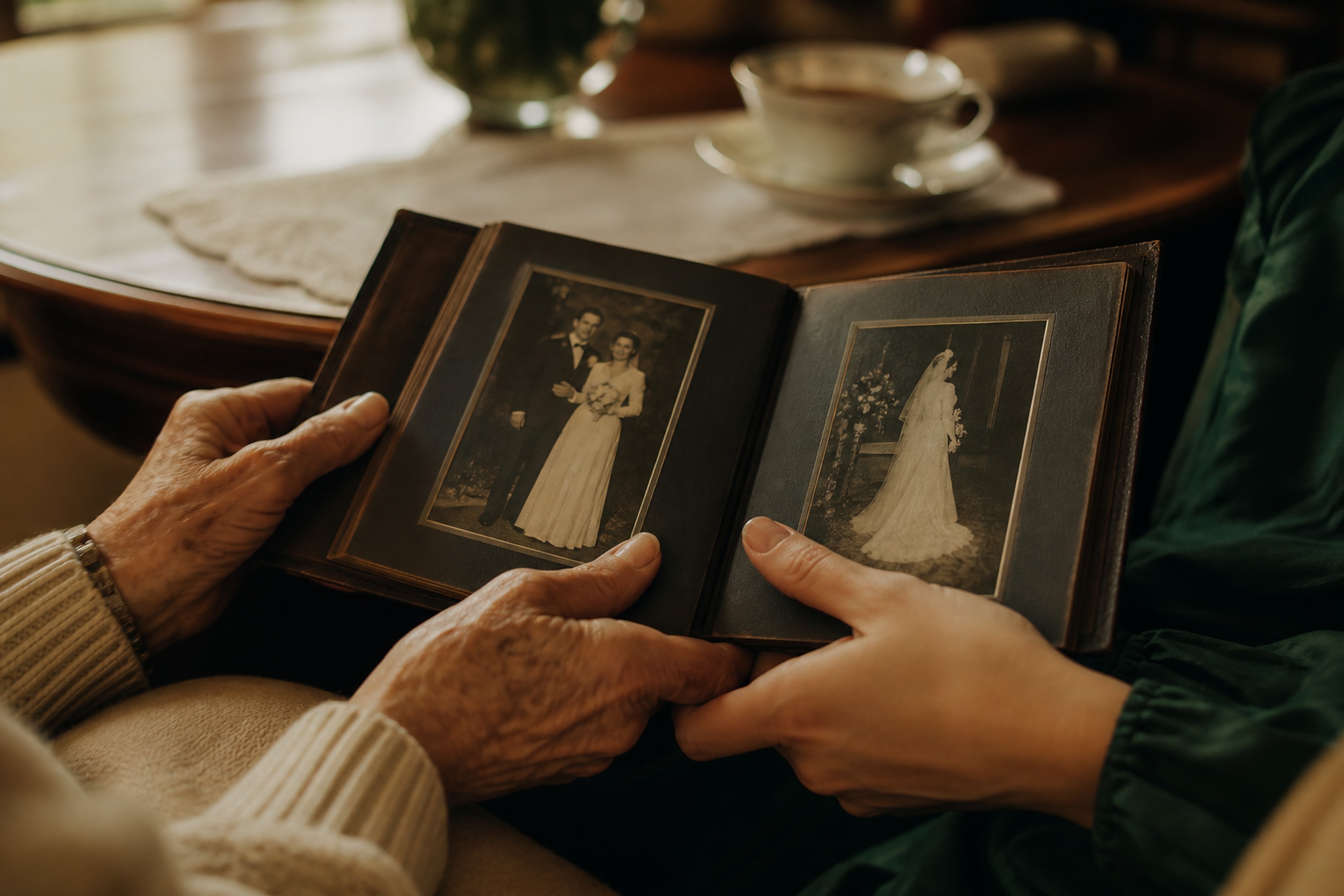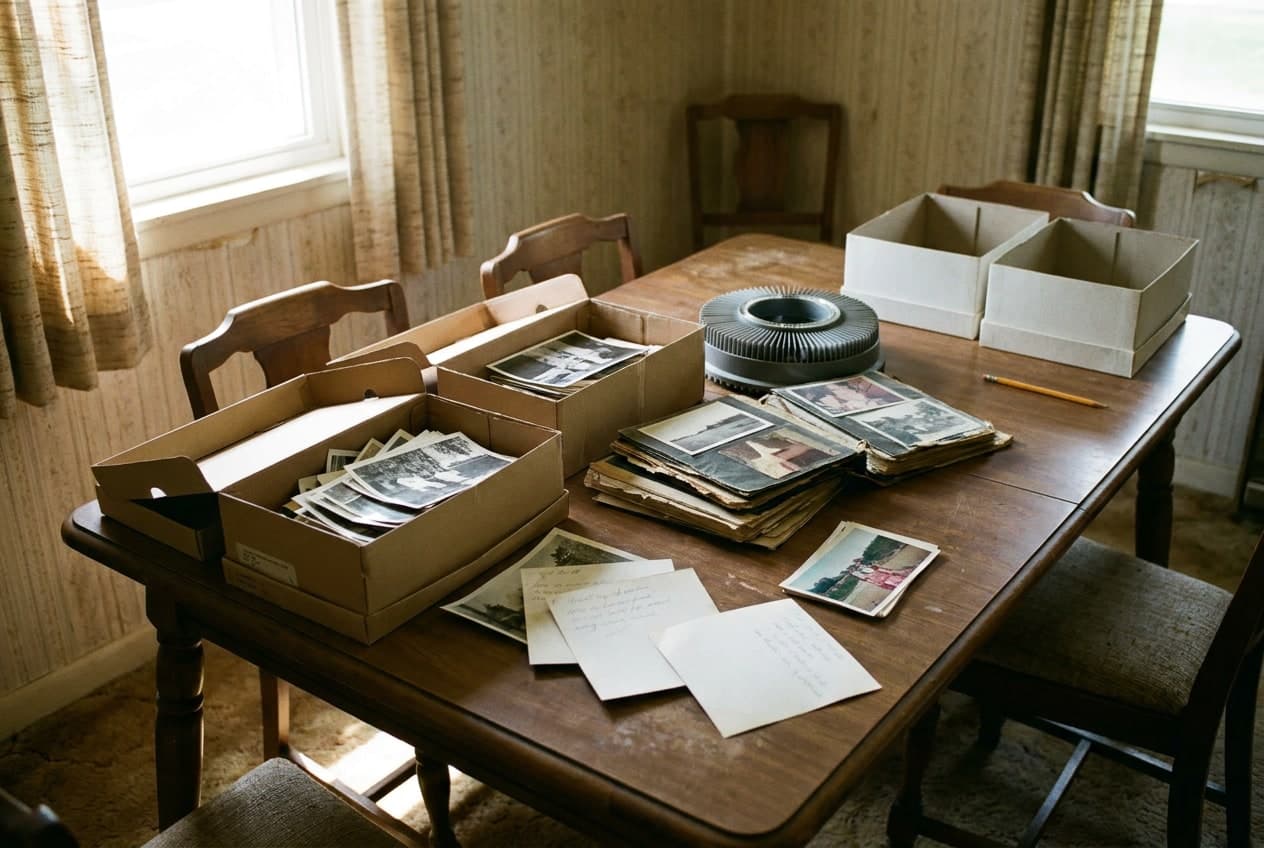
You have found the shoeboxes, the albums with the sticky pages, the slide carousels in the hall closet, and now you are standing in a room full of faces you half recognize while the rest of the house still needs to be emptied. Nobody wants to throw away Grandma. This guide walks you through how to gather the photos and keepsakes, make a fast first cut, keep what carries meaning, share the rest with family, and let go of the remainder without regret.
Why old family photos stall a downsizing
Photos are the one category in a house that cannot be replaced, and everyone in the room knows it. That knowledge makes people freeze. They open a box meant for a ten minute decision and surface two hours later having sorted nothing and cried twice.
The other common outcome is just as unhelpful. Every box gets taped shut and shipped to a storage unit or a sibling's garage, where it sits for another twenty years until the next generation faces the same pile with even less idea who the people are.
Neither of those is a plan. The goal is a smaller, labeled, cared for collection that the family actually looks at. Getting there takes a few hours of focused attention, done in the right order, and it goes much better if you decide up front that you are not sorting photos on the same afternoon you are clearing the kitchen cabinets.
Gather every photo in the house into one place first
Before you sort a single print, collect. Photos hide everywhere in an older home. Check the cedar chest, the bottom drawer of the bedroom dresser, the hall closet shelf above the coats, the desk in the spare room, the basement shelves next to the Christmas decorations, and the frames on every wall and end table.
Do not forget the formats that are not prints. Slide carousels, boxes of negatives, home movie reels, VHS and camcorder tapes, and the stack of CDs from the one hour photo counter all count. Pull them together with the albums so you can see the true size of the job.
Western Pennsylvania houses are hard on photographs. Basements run damp and attics bake in summer, so anything stored in either place deserves a quick look for mold spots, curling, or prints stuck together. Separate those gently and move them to a dry room. A print that is already damaged is often an easy early decision.
- Set up one long surface: a dining table or a folding table in the living room, with good light.
- Bring every box, album, frame, and envelope of negatives to that table.
- Have a pencil, a roll of painter's tape, a few empty boxes, and a trash bag ready before you sit down.
- Pick a stopping time and keep it. Fatigue is what turns a sort into a stall.
The fast first pass: what can go without a second thought
Most family photo collections are padded with prints nobody will miss. The one hour photo era produced doubles and triples of every roll, and people kept the blurry shots because throwing away a picture felt wrong. Your first pass is simply removing that padding.
Move quickly and do not study faces yet. You are looking for categories, not memories. Anything in the list below goes straight into the trash bag or a recycling pile for frames.
This pass usually shrinks the pile dramatically in an hour or two, which changes the mood in the room. A smaller pile feels possible. The emotional decisions come next, and they are much easier when you are not also wading through forty pictures of a parade float.
- Duplicates and near duplicates from the same roll. Keep the clearest one.
- Blurry, dark, or badly faded prints where you cannot tell who is in them.
- Scenery with no people: the view from a motel balcony, a sunset, a lake with no one in the frame.
- Pictures of strangers at someone else's event that no living family member can identify.
- Empty frames, broken frames, and the frames around photos you are keeping if you plan to store the prints flat.
Deciding what to keep when you cannot keep it all
Give the keep pile a physical limit before you start choosing. A single archival box, one album per decade, a container that fits on a closet shelf in the new apartment. The limit is what forces real choices and it is also what makes the collection usable later.
Then ask, for each photo that survives the first pass, whether it tells something a future family member would want to know. A posed school portrait does. The birthday cake from a party everyone remembers does. The fourteenth picture of the same backyard barbecue does not.
If the person who owns these photos is still living, sit with them for part of this. Have them say who is in the picture and roughly when it was taken, and write it lightly in pencil on the back. Pen bleeds and ballpoint dents the print. This is the step most families skip and most regret, because a photo of unnamed people stops being family history and becomes clutter within one generation.
Keep the originals of the ones that matter most even if you scan them. Faded chemical prints have a texture and a presence a screen does not, and the handwriting on the back is part of the object.
Scanning and sharing photos with family who live far away
Many downsizing families are spread across several states, which means the photos will land with one person and everyone else will worry about losing access. Scanning solves that. It does not have to mean digitizing every print; focus on the keep pile you just built.
You have two realistic paths. You can do it yourself with a phone scanning app or a flatbed scanner over a few evenings, which works well for a few hundred prints. Or you can send the keep pile to a photo scanning service, which makes sense when there are thousands of prints plus slides and negatives, and especially when nobody in the family has the time. Ask any service how they handle originals and how long they keep them.
Once scanned, put the files in a shared online album that every sibling and grandchild can open, and keep a second copy on a drive that lives somewhere other than the house being sold. Then decide who keeps the physical originals, and let that decision be practical rather than symbolic: the person with the dry closet and the habit of actually opening the box.
Home movies and tapes belong in the same conversation. Tapes degrade, and the players are disappearing. If there is a reel or cassette anyone cares about, get it converted now rather than at the next move.
Keepsakes beyond photos: the dress, the letters, the box of medals
Photos are rarely alone. Around them sit the wedding dress in a yellowing garment bag, the bundle of letters tied with ribbon, the service medals, the children's clay handprints, the church bulletins from every Easter since the sixties. These carry the same weight and respond to the same approach.
For each category, keep one representative piece rather than the whole set, and photograph the rest before it goes. One handprint plate, not twelve. The wedding dress stays if someone will wear or display it; otherwise a photograph of your mother in it says more than the dress in a bin.
Letters and diaries deserve a slower look because they may hold family history nobody knows. Set those aside in a labeled box to read later at your own table, not during the clear out. Military records and medals sometimes belong with a particular grandchild and sometimes with a veterans group; ask the family before assuming.
A simple habit helps here: a memory box per person. One box for Dad, one for Mom, one for each child who grew up in the house. When the box is full, the choosing is done.
What to do with the photos nobody in the family wants
After the keep pile and the shared scan, there is usually a middle pile: decent photos of people you can name, but more than anyone wants to store. Offer these outward before you throw them away. Cousins often want the pictures of their own parents that ended up in your family's box. Old friends appear in group shots and may be delighted to have them.
Photos of the town itself, old storefronts, the mill, a church that no longer stands, a street before the highway, are sometimes welcomed by the local historical society or library. Call first and ask what they collect; most want identified, dated images and have no room for unlabeled personal snapshots.
Whatever is left after that can go. Photographic prints generally do not belong in curbside recycling, so check your municipality's guidance and otherwise bag them with the household trash. Frames in good condition can be donated with the rest of the household goods. Give yourself permission here. You have kept the meaning. The paper was always just paper.
When the house has to be empty before you are ready to decide
Sometimes the closing date or the assisted living move comes faster than the photo sort. In that case do not force decisions under pressure. Pack every photo, album, slide tray, and keepsake box into a few clearly labeled bins marked HOLD and take them with you or to one designated sibling's home. Sorting at your own kitchen table a month later, with coffee and no truck waiting, produces better keeps and fewer regrets.
What you must not do is let the hold bins drift into a storage unit or a basement corner. Put a date on the calendar within a few months and treat it like the appointment it is.
If the rest of the house is what is standing between you and that calmer sort, that part can be handed off. Homeward Guide coordinates the whole transition for families in Pittsburgh and the surrounding counties, from the first sorting session through donation runs, removal, cleaning, and the final handoff, through one point of contact. Families often keep the photo bins for themselves and let everything else leave on schedule. Whether you call them at (724) 201-9992 or do it on your own, the principle holds: protect the irreplaceable first, then let the rest of the house move.
Common questions
- Should I throw away old family photos?
- Yes, some of them. Duplicates, blurry prints, scenery without people, and unidentified strangers can go without guilt. Keep the clear, labeled photos that tell your family's story, scan the best ones to share, and let the padding leave.
- What is the best way to store old photos after downsizing?
- Store them flat in acid free boxes or sleeves, in a dry closet inside the living space, never in a basement, attic, or garage. Write names and approximate dates in pencil on the back. Keep a scanned copy somewhere other than the house where the originals live.
- How do I divide family photos between siblings?
- Scan the keep pile first so everyone has the full collection digitally, which takes most of the heat out of the conversation. Then let each sibling claim the originals that feature their own childhood or their own children, and give the shared originals to whoever has dry storage and will actually open the box.
- Is it worth scanning all old family photos?
- Scanning everything is rarely worth the time or expense. Do the fast first pass to remove duplicates and blurry shots, decide what you are keeping, and scan that pile. For a few hundred prints a phone app works; for thousands plus slides, a scanning service saves weeks.